Data model
Explains the hierarchy of objects that describe everything about a place.
Every place is represented by a data model, a hierarchy of objects that describe everything about the place. The data model contains all objects that make up the 3D world, such as parts, terrain, lighting, and other environmental elements. It also contains objects that can control runtime behavior, such as scripts that modify properties, call methods and functions, and respond to events that enable dynamic behavior and interactivity.
The Roblox Engine uses the data model as a source of truth for a place's state, so it can simulate and render it on client devices. For more information on how the Roblox Engine interprets the data model, see Client-Server Runtime.
Objects#
You place and organize objects in the data model to describe a place in Roblox.
Every object in Roblox inherits from the Instance class, which defines
generic properties, methods, and events that are common to all objects. Objects
also define their own characteristics depending on the functionality the object
provides. There are many categories of objects with a wide variety of uses, but
you'll frequently work with BasePart and LuaSourceContainer
objects, commonly referred to as parts and scripts.
For a comprehensive list of all the features of the Roblox Engine, see the reference documentation.
3D building blocks#
BasePart is the core class for physically-simulated 3D building blocks in the world. It defines the properties and methods common to all physical objects with properties like position, size, and orientation.
| Object | Description |
|---|---|
Part |
A primitive part that can take the shape of a block, ball, cylinder, wedge, or corner wedge. |
MeshPart |
An imported mesh from 3D modeling software like Maya or Blender. |
TrussPart |
A truss beam that characters can climb like a ladder. |
While you can theoretically create a fully functional Roblox game using just simple parts, you'll most likely import meshes and combine primitive parts into more complex objects and structures through solid modeling.
Scripts#
You can add interactivity and behavior to your place's 3D world and define logic with scripts. You write scripts in the Luau programming language to do things like moving parts, calling other scripts, and responding to events. Because Roblox works in a client-server model, you can run scripts on the server, client, or have them communicate across the network boundary.
- A
Scriptobject represents a script that can only run on the server. - A
LocalScriptobject represents a script that can only run on the client. - A
ModuleScriptobject represents a reusable script that you canLuaGlobals.require()from both server and client scripts.
For scripts to behave properly, you must place them in the correct containers in the data model. For more information, see the Server and Client sections.
Object organization#
While you have a lot of flexibility in how you organize your data model, the Roblox Engine expects certain objects to be in certain container services which are objects that have specific behaviors and can affect the behaviors of the objects they contain. The main categories of container services include:
- Workspace —
Workspacestores all objects that render in the 3D world. - Environment — Containers like
LightingandSoundServicethat contain objects for environmental settings and elements. - Replication — Containers for content and logic that replicates between the
server and client, such as
ReplicatedStorageandReplicatedFirst. - Server — Containers for server-side only content and logic, such as
ServerScriptServiceandServerStorage. - Client — Containers for client-side content and logic, such as
StarterPlayerandStarterGui. - Chat — Containers for objects that enable chat features, such as
VoiceChatServiceandTextChatService.
The Roblox Engine has many more services that provide built-in functionality that you can call within your scripts. The Roblox Engine doesn't give these services special treatment in the data model. For more information, see services.
In addition, you can further organize your objects with the following objects:
- Folders — A
Folderis for organizational purposes and doesn't define any behavior. For example, you can use folders to group similar objects like a set of scripts in server storage. - Models — A
Modelis mainly intended for geometric groupings of parts, such as grouping together a desk set that includes a chair, table, and a lamp. To organize more complex sets, you can even nest models within models.
Workspace#
Workspace contains all objects that make up a place's 3D world. You can
add objects to the workspace to customize your 3D world, such as base parts,
mesh parts, and models. Clients render everything that appears in this container
and nothing outside of it, so you can control what users see and interact with
in your place. Although not actually rendered, you can also add scripts that are
parented to the parts and models that they are associated with. By default, the
workspace is pre-populated with a Terrain and Camera object.
Camera
Camera determines how the client views the 3D world. By default, there
is one camera in the workspace, but you can add multiple camera objects for
creating different perspectives and views. Every client takes these settings and
creates its own camera view that the server can't directly modify.
For example, you can set a camera to follow user movements or stay fixed in a particular location. You can also adjust the field of view, distance, and angle to create different visual effects of how users view your 3D world.
For more information, see customize the camera.
Terrain
Terrain lets you create landscapes for your place. You can apply a
material to the terrain to simulate desired natural environments, such as grass,
water, sand, or a custom material. Though you can only have one terrain object
for your 3D world and apply one material to that terrain, you can use the
Terrain Editor to edit regions of your
terrain.
For more information, see environmental terrain.
Environment#
Custom lighting can make your 3D world much more immersive and realistic. The Lighting service contains objects that control global lighting settings of your place, such as Atmosphere for simulating atmospheric effects or Sky to alter the sun, moon, and stars in your environments. In addition, you can use light sources to emit light from specific objects.
Adding audio to your games is also crucial for elevating your games to new heights. By strategically using positional and non-positional audio, you can immerse players into your worlds, provide them useful feedback for their actions, and direct their attention to what they need to do to be successful in their objectives.
Replication#
Replication is the process of the server synchronizing the state of your place with all connected clients. The Roblox Engine intelligently and automatically replicates data, physics, and chat messages between the server and client for many cases, but you can also specify certain objects to replicate by placing them in specific containers.
ReplicatedFirst
ReplicatedFirst contains objects that you want to replicate to a client
when it joins your place. It typically contains objects that are essential to
initialize a player, such as client-side LocalScript objects and the
objects associated with the scripts. All content in this container is replicated
from the server to the client only once.
ReplicatedStorage
ReplicatedStorage contains objects that are available to both the server
and connected clients. Any changes that occur on the client persist but won't be
replicated to the server. The server can overwrite changes on the client to
maintain consistency. This container is typically used for ModuleScript
objects that need to be shared and accessed by both Script (server-side)
and LocalScript (client-side) objects. In addition, you can use this
container to replicate any objects that don't need to exist in the 3D world
until needed, such as a ParticleEmitter for cloning and parenting to all
incoming character models.
For more information on how replication works, see client-server runtime.
Server#
The data model defines dedicated containers for server-side only objects that are never replicated to the client. This allows the server to affect client behavior and state without exposing the server's objects and logic to the client.
You can use remote events and functions to allow client-side communication with the server.
ServerScriptService
ServerScriptService contains Script objects,
ModuleScript objects that are required by server scripts, and other
scripting-related objects that are only meant for server use. If your scripts
require other, non-scripting objects, you must place them in
ServerStorage. Scripts in this container are never replicated to
clients, which allows you to have secure, server-side logic.
ServerStorage
ServerStorage contains objects that are only meant for server use. You
can use this container to store objects that you want to clone and parent to the
workspace or other containers at runtime. For example, you can store large
objects such as maps in this container until they are needed and move them into
the workspace only when required. This lets you decrease client network traffic
on initial join.
Scripts don't run when they are parented to this
container, but scripts inside ServerScriptService can access and run
ModuleScript objects in this container.
Client#
The client container services are meant for objects that are replicated to every
connected client. This category of containers replicate to every connected
client and typically contain 3D objects and associated LocalScript
objects. All objects you store in these containers are non-persistent across
sessions and reset every time a client rejoins. You can put objects in these
containers such as player GUIs, client-side scripts, and other objects that are
only relevant to the client.
When a client connects to a server, the Players container service
listens for users joining your place and creates a Player object for
every client. The server copies the objects from the client containers in the
edit data model to the corresponding location in the runtime data model inside
the Players object. The following table describes the original container
it resides on in the container and the resulting container they are copied to on
the client:
| Edit data model | Runtime data model | Notes |
|---|---|---|
StarterPack |
Player.Backpack |
Scripts that set up the player's inventory and generally contain Tool objects but often contains local scripts as well. |
StarterGui |
Player.PlayerGui |
Scripts that can manage the player's local GUI. When a player respawns, the contents of PlayerGui are emptied. The server copies the objects inside StarterGui into the PlayerGui. |
StarterPlayerScripts |
Player.PlayerScripts |
General purpose scripts for the client. For example, if you want to create special effects on the client when certain conditions are met, you can place a local script in this container to do that. The server cannot access this container. |
StarterCharacterScripts |
Player.Character |
Scripts that are copied to the client when they spawn. These scripts do not persist when the player respawns. |
ReplicatedFirst |
The contents of this container are replicated to all clients (but not back to the server) first, before anything else. |
For more information on edit and runtime data models, see client-server runtime.
Chat#
TextChatService
TextChatService represents the service that handles various,
in-game text chat tasks, such as managing channels, decorating messages,
filtering text, creating commands, and developing custom chats interfaces.
For more information, see text chat overview.
VoiceChatService
VoiceChatService represents the proximity-based voice chat
feature that simulates realistic communication based on how close you are to
other users. You can use this service to toggle the feature on and off.
For more information, see voice chat.
Folders and models#
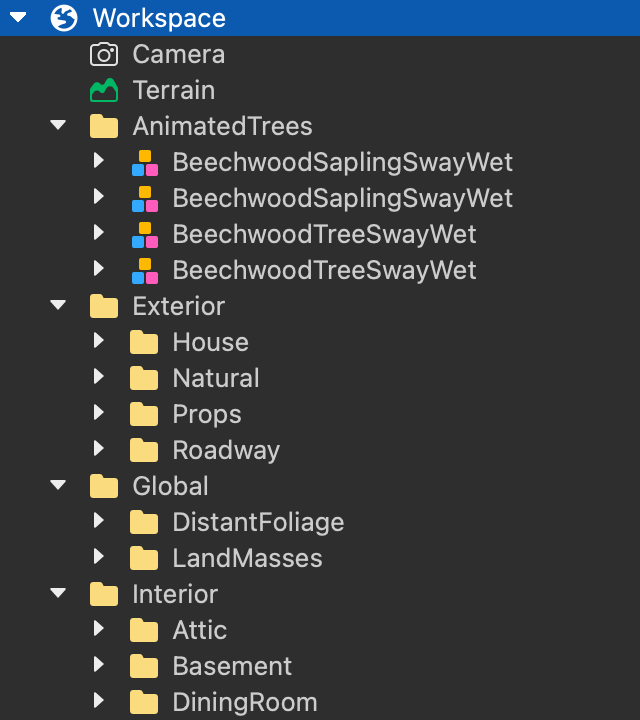
There are two primary methods for grouping objects in the data model: folders and models. Both are containers for objects, but they have different purposes.
- Folders are best for storing sections of an environment, such as the lobby or a combat arena.
- Models are used for sets of objects, such as a desk set that includes a chair, table, and a lamp. To organize more complex sets, nest models inside models.
You should always name your objects descriptively. This makes it easy to find and modify objects later on if needed.
Folders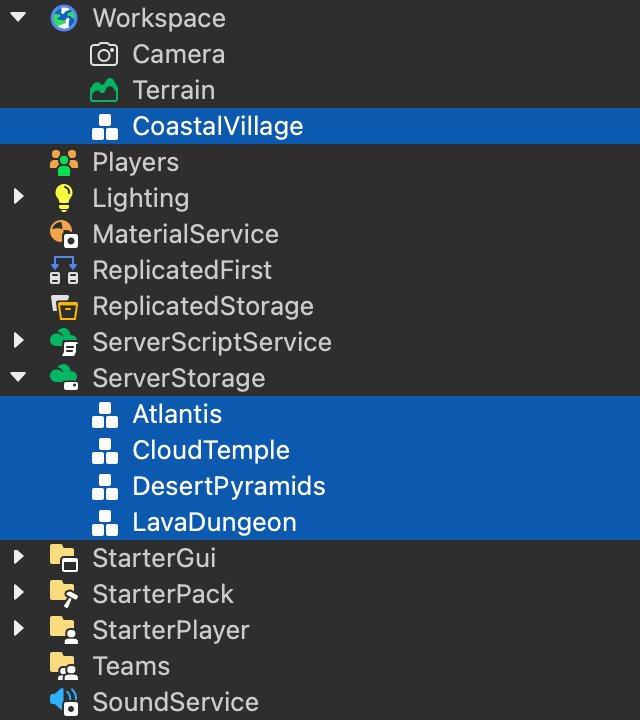
Workspace and ServerStorage