Class
EditableMesh
NotCreatable
Object which allows for the runtime creation and manipulation of meshes.
EditableMesh changes the applied visual mesh when linked to a
MeshPart, allowing for querying and modification of the mesh both in
Studio and in-game.
Enabling for published games#
For security purposes, using EditableMesh fails by default for published
games. To enable usage of EditableMesh, you must be 13+ age verified and ID
verified. After you are verified, open the
Creator Dashboard and toggle
on Enable Mesh / Image APIs. Remember to review the
Terms of Use
before enabling the toggle.
Permissions#
To prevent misuse, AssetService:CreateEditableMeshAsync() only allows
you to load and edit mesh assets if any of the following is true:
- Owned by or explicitly shared with the game owner.
- Owned by or explicitly shared with the logged in Studio user.
- Owned by or explicitly shared with the logged in player if the
EditableMeshis on the client side. - Owned by a group where the game owner, Studio user, or player has a role with permission to edit the group's assets. See Roles and permissions for more information.
See Grant permissions to learn how to share assets with users or groups.
The APIs throw an error if they are used to load an asset that does not meet the criteria above.
Memory limits#
Editable assets are currently expensive for memory usage. To minimize its
impact on client performance, EditableMesh has strict client-side memory
budgets, although the server, Studio, and plugins operate with unlimited
memory. Using FixedSize may help you stay
within the memory budget and, in some scenarios, linking one EditableMesh to
multiple MeshParts (multi-referencing) can help with memory
optimization.
Creation and display#
An EditableMesh can be created from an existing Content of a
MeshPart or a mesh ID using
AssetService:CreateEditableMeshAsync(), or a blank EditableMesh can
be created with AssetService:CreateEditableMesh(). It can then be
displayed, modified, and its collision model updated. Not all of the steps are
necessary; for example, you might want to create an EditableMesh just to
raycast without ever displaying it.
local AssetService = game:GetService("AssetService")

-- Create empty EditableMesh
local editableMesh = AssetService:CreateEditableMesh()

-- Create EditableMesh from asset ID
local editableMeshFromAsset = nil
local success, errorMessage = pcall(function()
	editableMeshFromAsset = AssetService:CreateEditableMeshAsync(Content.fromAssetId(ASSET_ID))
end)

-- Create EditableMesh from another EditableMesh
local editableMeshFromAnother = nil
local success, errorMessage = pcall(function()
	editableMeshFromAnother = AssetService:CreateEditableMeshAsync(Content.fromObject(OTHER_EDITABLE_MESH))
end)

-- Create EditableMesh from MeshPart
local editableMeshFromMeshPart = nil
local success, errorMessage = pcall(function()
	editableMeshFromMeshPart = AssetService:CreateEditableMeshAsync(MESH_PART.MeshContent)
end)
An EditableMesh is displayed when it's linked to a new MeshPart,
through AssetService:CreateMeshPartAsync(). You can create more
MeshPart instances that reference the same EditableMesh
Content, or link to an existing MeshPart through
MeshPart:ApplyMesh().
local AssetService = game:GetService("AssetService")
local Workspace = game:GetService("Workspace")

-- Create EditableMesh from asset ID
local editableMeshFromAsset = nil
local success, errorMessage = pcall(function()
	editableMeshFromAsset = AssetService:CreateEditableMeshAsync(Content.fromAssetId(ASSET_ID))
end)

-- Create new MeshPart linked to the EditableMesh
local newMeshPart = nil
local success, errorMessage = pcall(function()
	newMeshPart = AssetService:CreateMeshPartAsync(Content.fromObject(editableMeshFromAsset))
end)

-- Alternatively, link the new MeshPart created above to an existing MeshPart
local existingMeshPart = Workspace:FindFirstChild("EXISTING_MESH_PART")
existingMeshPart:ApplyMesh(newMeshPart)
To recalculate collision and fluid geometry after editing, you can again call
AssetService:CreateMeshPartAsync() and MeshPart:ApplyMesh() to
update an existing MeshPart. It's generally recommended to do this at
the end of a conceptual edit, not after individual calls to methods that
manipulate geometry. Visual changes to the mesh will always be immediately
reflected by the engine, without the need to call
AssetService:CreateMeshPartAsync().
Fixed-size meshes#
When creating an EditableMesh from an existing mesh asset (via
AssetService:CreateEditableMeshAsync()), the resulting editable mesh
is fixed-size by default. Fixed-size meshes are more efficient in terms of
memory but you cannot change the number of vertices, faces, or attributes.
Only the values of vertex attributes and positions can be edited.
local AssetService = game:GetService("AssetService")

-- Create EditableMesh without fixed-size default
local editableMeshFromAsset = nil
local success, errorMessage = pcall(function()
	editableMeshFromAsset = AssetService:CreateEditableMeshAsync(Content.fromAssetId(ASSET_ID), {FixedSize = false})
end)
Stable IDs#
Many EditableMesh methods take vertex, normal, UV, color and
face IDs. These are represented as integers in Luau but they require some
special handling. The main difference is that IDs are stable and they remain
the same even if other parts of the mesh change. For example, if an
EditableMesh has five vertices {1, 2, 3, 4, 5} and you remove vertex 4,
the new vertices will be {1, 2, 3, 5}.
Note that the IDs are not guaranteed to be in order and there may be holes in
the numbering, so when iterating through vertices or faces, you should iterate
through the table returned by GetVertices()
or GetFaces().
For debugging purposes, it can be very helpful to get a more readable string
for a stable ID with IdDebugString().
Split vertex attributes#
A vertex is a corner of a face, and topologically connects faces together. Each vertex has a single position, while its normal, UV coordinate, and color (with transparency) are stored per face corner. A vertex shared by multiple faces can use the same values on every face, or different values on each.
Sometimes it's useful for all faces that touch a vertex to use the same attribute values, but sometimes you'll want different faces to use different attribute values on the same vertex. For example, on a smooth sphere, each vertex will only have a single normal. In contrast, at the corner of a cube, the vertex will have 3 different normals (one for each adjacent face). You can also have seams in the UV coordinates or sharp changes in the vertex colors.
When creating faces with AddFace() or
AddTriangle(), each corner of the new face
is automatically assigned a normal, UV, and color attribute. If a vertex
already belongs to an existing face, the new face reuses that vertex's
existing attributes (producing smooth shading and continuous UVs). If the
vertex is new, fresh attribute IDs are created with default values
(auto-computed normal, UV of (0, 0), white color). To create a seam, you
should create new attributes and set them on the face. For example, this code
will create a sharp cube:
local AssetService = game:GetService("AssetService")

-- Given 4 vertex IDs, adds a new normal and a quad face, making a sharp quad
local function addSharpQuad(editableMesh, vid0, vid1, vid2, vid3)
	local nid = editableMesh:AddNormal() -- This creates a normal ID which is automatically computed

	local fid = editableMesh:AddFace({vid0, vid1, vid2, vid3})
	editableMesh:SetFaceNormals(fid, {nid, nid, nid, nid})
end

-- Makes a cube with creased edges between the 6 sides
local function makeSharpCube()
	local editableMesh = AssetService:CreateEditableMesh()

	local v1 = editableMesh:AddVertex(Vector3.new(0, 0, 0))
	local v2 = editableMesh:AddVertex(Vector3.new(1, 0, 0))
	local v3 = editableMesh:AddVertex(Vector3.new(0, 1, 0))
	local v4 = editableMesh:AddVertex(Vector3.new(1, 1, 0))
	local v5 = editableMesh:AddVertex(Vector3.new(0, 0, 1))
	local v6 = editableMesh:AddVertex(Vector3.new(1, 0, 1))
	local v7 = editableMesh:AddVertex(Vector3.new(0, 1, 1))
	local v8 = editableMesh:AddVertex(Vector3.new(1, 1, 1))

	addSharpQuad(editableMesh, v5, v6, v8, v7) -- Front
	addSharpQuad(editableMesh, v1, v3, v4, v2) -- Back
	addSharpQuad(editableMesh, v1, v5, v7, v3) -- Left
	addSharpQuad(editableMesh, v2, v4, v8, v6) -- Right
	addSharpQuad(editableMesh, v1, v2, v6, v5) -- Bottom
	addSharpQuad(editableMesh, v3, v7, v8, v4) -- Top

	editableMesh:RemoveUnused()
	return editableMesh
endWinding#
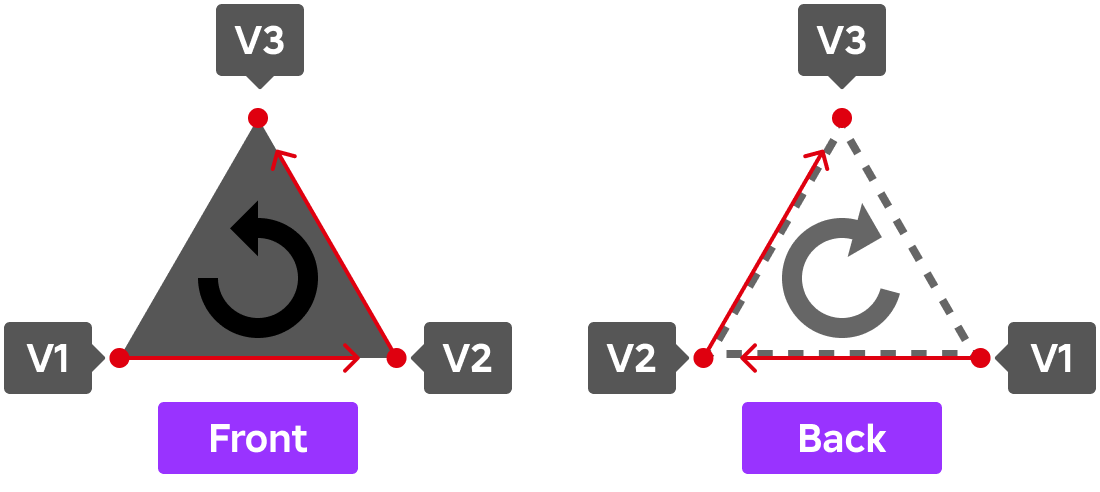
Mesh faces have a front side and a back side. When drawing meshes, only the
front of the faces are drawn by default, although you can change this by
setting the mesh' DoubleSided property to true.
The order of the vertices around the face determines whether you are looking at the front or the back. The front of the face is visible when the vertices go counterclockwise around it.
FACS poses#
Animatable heads use the Facial Action Coding System (FACS). See the
FACS poses reference
for helpful information when using
GetFacsPoses() and similar methods.
Each FACS pose is specified by an FacsActionUnit value. For the FACS
pose, virtual bones can each have a CFrame that transforms the
bones' initial CFrame in the bind pose of the mesh into the
CFrame for that FACS action unit's pose. All bone
CFrames are in the mesh's local space.
These FACS poses are blended together during animation. Sometimes, the
blending of the base poses produces poor results. In those cases, you can
override the blending of specific combinations of base poses with a
corrective pose
that is more pleasing. A corrective pose is specified by 2 or 3
FacsActionUnit values. Like a base FACS pose, for a corrective pose,
virtual bones can each have a CFrame that transforms the bones'
initial CFrame in the bind pose of the mesh into the
CFrame for that FACS corrective.
Please note that corrective poses that operate on both left and right action
units are not currently expressible. For example, using LeftCheekPuff and
RightEyeClosed together in a corrective pose is not currently possible.
Batching#
The batch methods let you create, read, update, and remove many mesh
elements in a single call instead of invoking the singular methods
(AddVertex(),
SetPosition(),
GetColor(), and so on) once per element.
Batching your mesh operations is typically much more performant than handling
them one by one.
Rather than one method per attribute, each batch method shares a small set of
general entry points and uses an MeshAttribute value (or the type
already encoded in each mesh ID) to determine which attribute you mean. For
example, BatchSetValues() sets positions
when called with vertex IDs, but sets normals when called with normal IDs. You
cannot mix-and-match ID types within a single call.
Batch setters take parallel arrays: element i of every argument array
describes the same logical operation. In
BatchSetValues(ids, values), values[i]
is written to ids[i]. All argument arrays must be the same length or the
call errors. Batch getters take an array of IDs and return results in the same
order.
If a mesh ID is invalid, batching still applies updates to all elements before the invalid ID, then stops.
Limitations#
EditableMesh currently has a limit of 60,000 vertices and 20,000 triangles.
Faces can be triangles or quads, and each quad counts as 2 triangles toward
the triangle limit. Attempting to add too many vertices or triangles will
cause an error.
Properties 1#
FixedSizeboolean | Returns true if a mesh is fixed-size.Write: RobloxEngineSecurityReadSafeReadOnlyNotReplicated |
FixedSize: boolean#
ReadOnlyNotReplicatedWrite: RobloxEngineSecurityReadSafe
Fixed-sized meshes allow changing the values of vertex attributes but do not allow vertices and faces to be added or deleted.
Methods 95#
| AddBone | Adds a new bone and returns a bone ID. |
| AddColor | Adds a new color to the geometry and returns a color ID. |
| AddFace | Adds a new triangle or quad face to the mesh and returns a face ID. |
| AddNormal | Adds a new normal to the geometry and returns a normal ID. |
| AddTriangle | Adds a new triangle to the mesh and returns a face ID. |
| AddUV | Adds a new UV to the geometry and returns a UV ID. |
| AddVertex | Adds a new vertex to the geometry and returns a vertex ID. |
| BatchAdd | Creates new mesh elements of the given attribute type and returns their IDs.CustomLuaState |
| BatchGetFaceAttributes | Returns the per-corner attribute IDs for each face in a batch.SafeCustomLuaState |
| BatchGetValues | Returns attribute values for each ID in a batch.SafeCustomLuaState |
| BatchGetVertexAttributes | Returns the attribute IDs associated with each vertex in a batch.SafeCustomLuaState |
| BatchGetVertexFaceAttributes | Returns the attribute ID at each specified corner for a batch of vertex–face pairs.SafeCustomLuaState |
| BatchRemove | Removes a batch of faces.CustomLuaState |
| BatchSetFaceAttributes | Sets the per-corner attribute IDs for each face in a batch.CustomLuaState |
| BatchSetValues | Writes attribute values to a batch of mesh element IDs.CustomLuaState |
| BatchSetVertexFaceAttributes | Sets the attribute at a specific corner for each vertex–face pair in a batch.CustomLuaState |
| Clear | Clears all of an EditableMesh's geometry. |
| Destroy | Destroys the mesh. |
| FindClosestPointOnSurface | Finds the closest point on the mesh's surface.Safe |
| FindClosestVertex | Finds the closest vertex to a specific point in space.Safe |
| FindVerticesWithinSphere | Finds all vertices within a specific sphere.Safe |
| GetAdjacentFaces | Returns a list of faces adjacent to a given face.Safe |
| GetAdjacentVertices | Returns a list of vertices adjacent to a given vertex.Safe |
| GetBoneByName | Finds the bone ID of the bone with the given name.Safe |
| GetBoneCFrame | Returns the initial CFrame of the bone in the bind pose of the
mesh.Safe |
| GetBoneIsVirtual | Returns true if the bone is virtual.Safe |
| GetBoneName | Returns the bone name.Safe |
| GetBoneParent | Returns the parent bone ID, if any.Safe |
| GetBones | Returns all bones of the mesh.Safe |
| GetCenter | Returns the center of the mesh's axis-aligned bounding box.Safe |
| GetColor | Returns the color for the given color ID.Safe |
| GetColorAlpha | Returns the color alpha (transparency) at the given color ID.Safe |
| GetColors | Returns all colors of the mesh.SafeCustomLuaState |
| GetFaceColors | Returns the face's color IDs for the vertices on the face.SafeCustomLuaState |
| GetFaceNormals | Returns the face's normal IDs for the vertices on the face.SafeCustomLuaState |
| GetFaces | Returns all faces of the mesh.SafeCustomLuaState |
| GetFacesWithAttribute | Returns a list of faces that use a given attribute ID.SafeDeprecated |
| GetFacesWithColor | Returns an array of face IDs that use the given color ID.SafeCustomLuaState |
| GetFacesWithNormal | Returns an array of face IDs that use the given normal ID.SafeCustomLuaState |
| GetFacesWithUV | Returns an array of face IDs that use the given UV ID.SafeCustomLuaState |
| GetFaceUVs | Returns the face's UV IDs for the vertices on the face.SafeCustomLuaState |
| GetFaceVertices | Returns the face's vertex IDs.SafeCustomLuaState |
| GetFacsCorrectivePose | Returns bone IDs and bone CFrames for all bones in a
specific FACS corrective pose.Safe |
| GetFacsCorrectivePoses | Returns all FACS corrective poses that are in use.Safe |
| GetFacsPose | Returns bone IDs and bone CFrames for all bones in a
specific FACS action unit.Safe |
| GetFacsPoses | Returns all FACS action units that have poses defined.Safe |
| GetNormal | Returns the normal vector for the given normal ID.Safe |
| GetNormals | Returns all normals of the mesh.SafeCustomLuaState |
| GetPosition | Gets the position of a vertex.Safe |
| GetSize | Returns the size of the mesh's axis-aligned bounding box.Safe |
| GetUV | Returns UV coordinates at the given UV ID.Safe |
| GetUVs | Returns all UVs of the mesh.SafeCustomLuaState |
| GetVertexBones | Returns all bone IDs that are associated with the vertex for skinning.Safe |
| GetVertexBoneWeights | Returns skinning blend weights for each bone that is associated with the vertex.Safe |
| GetVertexColors | Returns the color IDs of the faces attached to the given vertex.SafeCustomLuaState |
| GetVertexFaceColor | Returns the color ID of a vertex/face pair.Safe |
| GetVertexFaceNormal | Returns the normal ID of a vertex/face pair.Safe |
| GetVertexFaces | Returns the face IDs of the faces attached to the given vertex.SafeCustomLuaState |
| GetVertexFaceUV | Returns the UV ID of a vertex/face pair.Safe |
| GetVertexNormals | Returns the normal IDs of the faces attached to the given vertex.SafeCustomLuaState |
| GetVertexUVs | Returns the UV IDs of the faces attached to the given vertex.SafeCustomLuaState |
| GetVertices | Returns all vertices as a list of vertex IDs.Safe |
| GetVerticesWithAttribute | Returns a list of vertices that use a given attribute ID.SafeDeprecated |
| GetVerticesWithColor | Returns an array of vertex IDs that use the given color ID.SafeCustomLuaState |
| GetVerticesWithNormal | Returns an array of vertex IDs that use the given normal ID.SafeCustomLuaState |
| GetVerticesWithUV | Returns an array of vertex IDs that use the given UV ID.SafeCustomLuaState |
| IdDebugString | Returns a string describing an ID, useful for debugging purposes. |
| MergeVertices | Merges vertices that touch together. |
| RaycastLocal | Casts a ray and returns the intersection point, face ID, and barycentric coordinates.Safe |
| RemoveBone | Removes a bone using its bone ID. |
| RemoveFace | Removes a face using its face ID. |
| RemoveUnused | Removes all unused vertices, normals, UVs, and colors, and returns the removed IDs. |
| ResetNormal | Reset this normal ID to be automatically calculated. |
| SetBoneCFrame | Set the initial CFrame for a bone in the mesh's bind pose. |
| SetBoneIsVirtual | Set whether a bone is virtual. |
| SetBoneName | Sets the name for a bone. |
| SetBoneParent | Set a parent for a bone. |
| SetColor | Sets the color for a color ID. |
| SetColorAlpha | Sets the color alpha (transparency) for a color ID. |
| SetFaceColors | Sets the face's vertex colors to new color IDs.CustomLuaState |
| SetFaceNormals | Sets the face's vertex normals to new normal IDs.CustomLuaState |
| SetFaceUVs | Sets the face's vertex UVs to new UV IDs.CustomLuaState |
| SetFaceVertices | Sets the face's vertices to new vertex IDs.CustomLuaState |
| SetFacsBonePose | Set CFrame for an individual bone in a specific FACS action
unit. |
| SetFacsCorrectivePose | Set pose for all bones in a specific FACS corrective pose. |
| SetFacsPose | Set pose for all bones in a specific FACS action unit. |
| SetNormal | Set the normal for a normal ID. |
| SetPosition | Sets a vertex position in the mesh's local object space. |
| SetUV | Sets UV coordinates for a UV ID. |
| SetVertexBones | Assign a list of bones with the vertex for skinning. |
| SetVertexBoneWeights | Sets skinning blend weights for each bone associated with the vertex. |
| SetVertexFaceColor | Sets the color ID of a vertex/face pair. |
| SetVertexFaceNormal | Sets the normal ID of a vertex/face pair. |
| SetVertexFaceUV | Sets the UV ID of a vertex/face pair. |
| Triangulate | Splits all faces on the mesh to be triangles. |
AddBone(boneProperties: Dictionary): int64#
Adds a new bone to the mesh and returns a bone ID that persists across topology changes. An error is thrown if the bone name is already in use, the parent ID is invalid, or the mesh already contains the maximum number of bones.
| Name | Type | Default | Description |
|---|---|---|---|
boneProperties | Dictionary | Options table containing bone parameters:
|
Returns
int64— Bone ID of the new bone.
AddColor(color: Color3, alpha: float): int64#
Adds a new vertex color attribute to the mesh and returns a color ID.
| Name | Type | Default | Description |
|---|---|---|---|
color | Color3 | The new color. | |
alpha | float | The color alpha (transparency). 0 is fully transparent, and 1 is
fully opaque. |
Returns
int64— Color ID of the new color.
AddFace(vertexIds: Array): int64#
Adds a new face from an array of vertex IDs and returns a stable face ID.
A face is either a triangle (3 vertex IDs) or a quad (4 vertex
IDs); any other count throws an error. For adding triangles specifically,
it is preferable to use AddTriangle(),
which is equivalent but slightly more performant as it avoids constructing
an array for the vertices.
For rendering and collision, each quad is internally split into 2 triangles, so a quad counts as 2 triangles toward the mesh's triangle limit.
Automatic attribute assignment#
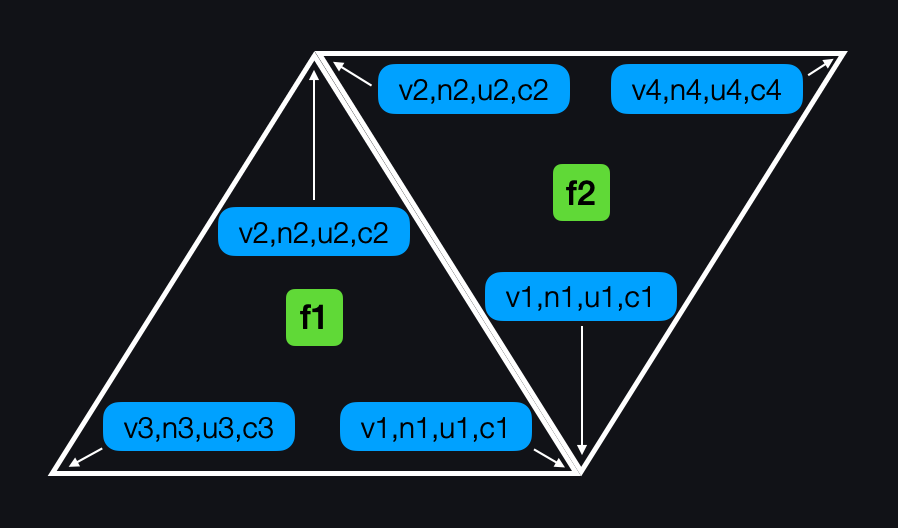
AddFace() only takes vertex IDs as arguments. For each vertex of the new
face, it automatically assigns normal, UV, and color attributes using the
following logic:
- If the vertex already belongs to another face, the new face corner reuses the same normal, UV, and color IDs from the existing face. This produces smooth shading and continuous UVs across adjacent faces by default.
- If the vertex does not yet belong to any face, new normal, UV, and
color IDs are created with default values (auto-computed normal, UV
coordinate of
(0, 0), and white color).
Overriding attributes after adding a face#
The auto-assigned attributes can be customized after adding a face. The approach depends on whether you want to change attribute values while keeping the topology intact, or create entirely new attribute IDs to add or remove seams between faces.
To change values in-place, retrieve the auto-created IDs with methods
like GetVertexFaceUV() and set
their values directly. This is more performant and avoids leaving unused
IDs in the mesh:
-- Create a triangle
local faceId = editableMesh:AddFace({v0, v1, v2})

-- Get the UV IDs that were automatically created
local uvId0 = editableMesh:GetVertexFaceUV(v0, faceId)
local uvId1 = editableMesh:GetVertexFaceUV(v1, faceId)
local uvId2 = editableMesh:GetVertexFaceUV(v2, faceId)

-- Set UV values on those existing UV IDs
editableMesh:SetUV(uvId0, Vector2.new(0, 0))
editableMesh:SetUV(uvId1, Vector2.new(1, 0))
editableMesh:SetUV(uvId2, Vector2.new(0, 1))
To create a seam — where the same vertex needs different attribute
values on different faces (for example, a UV seam or a sharp edge) —
create new attribute IDs with AddUV(),
AddNormal(), or
AddColor(), then assign them to the face
with SetFaceUVs(),
SetFaceNormals(), or
SetFaceColors():
-- Create a triangle
local faceId = editableMesh:AddFace({v0, v1, v2})

-- Create new UV IDs with custom coordinates
local uv0 = editableMesh:AddUV(Vector2.new(0, 0))
local uv1 = editableMesh:AddUV(Vector2.new(1, 0))
local uv2 = editableMesh:AddUV(Vector2.new(0, 1))

-- Replace the face's UV IDs (creates a seam if the vertex had different UVs on another face)
editableMesh:SetFaceUVs(faceId, {uv0, uv1, uv2})
Normal sharing and smooth vs. sharp edges#
Because new faces reuse normal IDs from adjacent faces by default, meshes
appear smooth. To create a sharp edge (crease) between faces, create a
separate normal ID for each face and assign it with
SetFaceNormals():
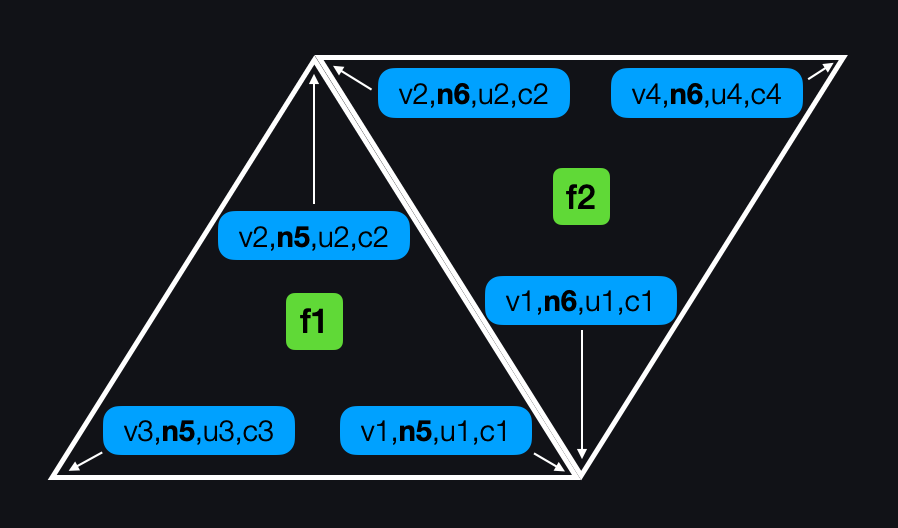
-- Two triangles sharing vertices v0 and v1, but with a sharp edge between them
local fid1 = editableMesh:AddFace({v0, v1, v2})
local fid2 = editableMesh:AddFace({v0, v3, v1})

-- Create separate normals for each face to produce a hard edge
local n1 = editableMesh:AddNormal() -- Auto-computed for fid1
local n2 = editableMesh:AddNormal() -- Auto-computed for fid2
editableMesh:SetFaceNormals(fid1, {n1, n1, n1})
editableMesh:SetFaceNormals(fid2, {n2, n2, n2})
See also SetNormal() to manually specify
a normal vector, and ResetNormal() to
revert a normal back to automatic computation.
| Name | Type | Default | Description |
|---|---|---|---|
vertexIds | Array | Array of the new face's vertex IDs, in order around the face. Provide 3 IDs to create a triangle or 4 IDs to create a quad. |
Returns
int64— Face ID of the new face.
AddNormal(normal: Vector3?): int64#
Adds a new normal to the geometry and returns a normal ID. If the normal value isn't specified, the normal will be automatically calculated.
| Name | Type | Default | Description |
|---|---|---|---|
normal | Vector3? | The normal vector. If the normal value isn't specified, the normal will be automatically calculated. |
Returns
int64— Normal ID of the new normal.
AddTriangle(vertexId0: int64, vertexId1: int64, vertexId2: int64): int64#
Adds a new triangle to the mesh and returns a stable face ID. This is
equivalent to passing an array of 3 vertex IDs to
AddFace(), but is slightly more performant
as it avoids constructing an array for each call.
See AddFace() for information on how all
faces are added, including those added by
AddTriangle(). This includes details
related to automatic attribute assignment, overriding attributes, and
more.
| Name | Type | Default | Description |
|---|---|---|---|
vertexId0 | int64 | ID of the first vertex of the triangle. | |
vertexId1 | int64 | ID of the second vertex of the triangle. | |
vertexId2 | int64 | ID of the third vertex of the triangle. |
Returns
int64— Stable face ID of the new face.
AddUV(uv: Vector2): int64#
Adds a new UV coordinate attribute to the mesh and returns a UV ID.
| Name | Type | Default | Description |
|---|---|---|---|
uv | Vector2 | The new UV coordinate. |
Returns
int64— UV ID of the new UV.
AddVertex(p: Vector3): int64#
Adds a new vertex to the mesh and returns a vertex ID. The position is specified in the mesh's local object space. An error is thrown if the mesh already contains 60,000 vertices.
| Name | Type | Default | Description |
|---|---|---|---|
p | Vector3 | Position in the mesh's local object space. |
Returns
int64— Vertex ID of the new vertex.
BatchAdd(attr: MeshAttribute, data: Array): Array#
CustomLuaState
Creates new mesh elements of the given attribute type and returns their
IDs in the same order as the input data. This method always requires an
explicit MeshAttribute because its input is raw values with no
existing IDs to inspect. Throws an error if the attribute type is invalid,
the data format does not match, or adding the elements would exceed mesh
limits.
local vIds = mesh:BatchAdd(Enum.MeshAttribute.Vertex, positions)     -- Positions: {Vector3}
local nIds = mesh:BatchAdd(Enum.MeshAttribute.Normal, normals)       -- Normals: {Vector3}
local uIds = mesh:BatchAdd(Enum.MeshAttribute.UV, uvs)               -- UVs: {Vector2}
local cIds = mesh:BatchAdd(Enum.MeshAttribute.Color, colors, alphas) -- Colors: {Color3}, Alphas: {number}
local fIds = mesh:BatchAdd(Enum.MeshAttribute.Face, {
    {vIds[1], vIds[2], vIds[3]},
    {vIds[1], vIds[3], vIds[4]},
})| Name | Type | Default | Description |
|---|---|---|---|
attr | MeshAttribute | The MeshAttribute type of element to create. | |
data | Array | Values to initialize the new elements. An array of Vector3
for Vertex or Normal; an
array of Vector2 for UV; an array of
Color3 followed by a matching array of alpha numbers (same
length) for Color; a 2D array of vertex-ID arrays
for Face. |
Returns
Array— Ordered array of new element IDs matching the input order.
BatchGetFaceAttributes(attr: MeshAttribute, faceIds: Array): Array#
CustomLuaStateSafe
Returns, for each face, the array of per-corner attribute IDs, one per
corner in the same order as
GetFaceVertices().
local faceNormals = mesh:BatchGetFaceAttributes(Enum.MeshAttribute.Normal, faceIds) -- {{normalId}}
local faceVerts = mesh:BatchGetFaceAttributes(Enum.MeshAttribute.Vertex, faceIds) -- {{vertexId}}| Name | Type | Default | Description |
|---|---|---|---|
attr | MeshAttribute | The attribute to retrieve for each face's corners. Must be
MeshAttribute.Vertex, MeshAttribute.Normal,
MeshAttribute.Color, or MeshAttribute.UV;
MeshAttribute.Face is not supported and throws an error. | |
faceIds | Array | Faces to query. |
Returns
Array— 2D array whereresult[i]is the array of attribute IDs at the corners offaceIds[i].
BatchGetValues(ids: Array): Tuple#
CustomLuaStateSafe
Returns attribute values for the given IDs in the same order as the input. Passing an empty array returns an empty result.
local positions = mesh:BatchGetValues(vertexIds)     -- {Vector3}
local normals = mesh:BatchGetValues(normalIds)       -- {Vector3}
local uvs = mesh:BatchGetValues(uvIds)               -- {Vector2}
local colors, alphas = mesh:BatchGetValues(colorIds) -- {Color3}, {number}| Name | Type | Default | Description |
|---|---|---|---|
ids | Array | IDs of the elements to read. All must be the same attribute type —
vertex, normal, color, or UV. The attribute is determined by the ID
type, so no MeshAttribute argument is needed. Mixing types, or
passing face or bone IDs, throws an error. |
BatchGetVertexAttributes(attr: MeshAttribute, vertexIds: Array): Array#
CustomLuaStateSafe
Returns, for each vertex, the array of associated attribute IDs, gathered
across all faces adjacent to that vertex. For example, using
MeshAttribute.Face returns every face that references each vertex.
local adjFaces = mesh:BatchGetVertexAttributes(Enum.MeshAttribute.Face, vertexIds) -- {{faceId}}| Name | Type | Default | Description |
|---|---|---|---|
attr | MeshAttribute | The attribute type to look up. Must be MeshAttribute.Face
(faces that reference each vertex), MeshAttribute.Normal,
MeshAttribute.Color, or MeshAttribute.UV;
MeshAttribute.Vertex is not supported and throws an error (to
read vertex positions, use
BatchGetValues()). | |
vertexIds | Array | Vertices to query. |
Returns
Array— 2D array whereresult[i]is the array of attribute IDs associated withvertexIds[i].
BatchGetVertexFaceAttributes(attr: MeshAttribute, vertexIds: Array, faceIds: Array): Array#
CustomLuaStateSafe
Returns the attribute ID at each corner specified by a vertex–face pair.
local cornerColors = mesh:BatchGetVertexFaceAttributes(Enum.MeshAttribute.Color, vertexIds, faceIds)| Name | Type | Default | Description |
|---|---|---|---|
attr | MeshAttribute | The attribute to retrieve. Must be MeshAttribute.Normal,
MeshAttribute.Color, or MeshAttribute.UV;
MeshAttribute.Vertex and MeshAttribute.Face are not
supported and throw an error. | |
vertexIds | Array | Vertices that identify each corner. | |
faceIds | Array | Faces that identify each corner. Must be the same length as
vertexIds. |
Returns
Array— Array of attribute IDs at each corner, in the same order as the inputs.
BatchRemove(faceIds: Array): ()#
CustomLuaState
Removes a batch of faces. As with
RemoveFace(), the vertices and
attributes used by the removed faces are not automatically deleted; call
RemoveUnused() afterward to clean up
unused elements.
mesh:BatchRemove(faceIds)| Name | Type | Default | Description |
|---|---|---|---|
faceIds | Array | Face IDs to remove. An invalid or already-removed ID throws an error and removes nothing; duplicate IDs are collapsed to a single removal. |
Returns
()
BatchSetFaceAttributes(faceIds: Array, attrIdArrays: Array): ()#
CustomLuaState
Sets the per-corner attribute IDs for each face.
-- Assign normal IDs to every corner of two faces
mesh:BatchSetFaceAttributes(faceIds, {
	{n1, n2, n3},
	{n4, n5, n6},
})| Name | Type | Default | Description |
|---|---|---|---|
faceIds | Array | Face IDs to update. Must be the same length as attrIdArrays. | |
attrIdArrays | Array | 2D array. attrIdArrays[i] is the list of attribute IDs for the
corners of faceIds[i], in order. Each inner array must have one
entry per corner of the face. All IDs must be of the same attribute
type — vertex, normal, color, or UV; mixing types (or passing another
ID type) throws an error. |
Returns
()
BatchSetValues(ids: Array, values: Array): ()#
CustomLuaState
Writes attribute values to the given IDs. values[i] is written to
ids[i]; the ids and values arrays must be the same length, unless
values is nil to reset normals.
For color IDs, pass an array of Color3 to set the colors, or an
array of numbers to set the alphas. Mixing types in one call is an error.
mesh:BatchSetValues(vertexIds, positions) -- Positions: {Vector3}
mesh:BatchSetValues(normalIds, normals)   -- Normals: {Vector3}
mesh:BatchSetValues(uvIds, uvs)           -- UVs: {Vector2}
mesh:BatchSetValues(colorIds, colors)     -- Colors: {Color3}
mesh:BatchSetValues(colorIds, alphas)     -- Alphas: {number}
mesh:BatchSetValues(normalIds, nil) -- Resets each normal to auto-computed| Name | Type | Default | Description |
|---|---|---|---|
ids | Array | IDs of the elements to write. All must be the same attribute type —
vertex, normal, color, or UV. The attribute is determined by the ID
type, so no MeshAttribute argument is needed. Mixing types, or
passing face or bone IDs, throws an error. | |
values | Array | Values to assign. Type depends on the ID type: Vector3 for
vertex or normal IDs, Vector2 for UV IDs, Color3
or a number for color IDs. Pass nil for normal IDs to reset each
normal to auto-computed values, equivalent to calling
ResetNormal() on each. |
Returns
()
BatchSetVertexFaceAttributes(vertexIds: Array, faceIds: Array, attrIds: Array): ()#
CustomLuaState
Sets the attribute at a specific corner — identified by a vertex–face pair
— for each element in the batch. For each index i, the attribute at
corner (vertexIds[i], faceIds[i]) is set to attrIds[i].
mesh:BatchSetVertexFaceAttributes(vertexIds, faceIds, colorIds)| Name | Type | Default | Description |
|---|---|---|---|
vertexIds | Array | Vertex IDs that identify each corner. | |
faceIds | Array | Face IDs that identify each corner. Must be the same length as
vertexIds. | |
attrIds | Array | Attribute IDs to assign, one per pair; must be the same length as
vertexIds. All must be the same attribute type — normal, color, or
UV; passing a vertex or face ID throws an error. |
Returns
()
Clear(): ()#
Removes all vertex data (including positions, normals, UV coordinates, and
colors), faces, bones, and FACS data without destroying the
EditableMesh or its allocated space.
This method cannot be called on a fixed-size mesh (where
FixedSize is true). Attempting to do so
throws an error because fixed-size meshes do not allow adding or removing
elements.
Returns
()
Destroy(): ()#
Destroys the contents of the mesh, immediately reclaiming used memory.
Returns
()
FindClosestPointOnSurface(point: Vector3): Tuple#
Safe
Finds the closest point on the mesh's surface. Returns the face ID, point
on the mesh in local object space, the barycentric coordinates of the
position within the face, and the 3 vertex IDs that the barycentric
coordinates correspond to. See
RaycastLocal() for more information on
barycentric coordinates, including how they apply to quad faces. When the
mesh is skinned, this query operates against the bind-pose geometry, not
the deformed mesh as it appears at runtime.
| Name | Type | Default | Description |
|---|---|---|---|
point | Vector3 | Point position in the mesh's local object space. |
Returns
Tuple— Tuple of the face ID, point on the mesh in local object space, the barycentric coordinate of the position within the face, and the 3 vertex IDs that the barycentric coordinate weights.
FindClosestVertex(toThisPoint: Vector3): int64#
Safe
Finds the closest vertex to a specific point in space and returns a vertex ID. When the mesh is skinned, this query operates against the bind-pose geometry, not the deformed mesh as it appears at runtime.
| Name | Type | Default | Description |
|---|---|---|---|
toThisPoint | Vector3 | Point position in the mesh's local object space. |
Returns
int64— Closest vertex ID to the specified point in space.
FindVerticesWithinSphere(center: Vector3, radius: float): Array#
Safe
Finds all vertices within a specific sphere and returns a list of vertex IDs. When the mesh is skinned, this query operates against the bind-pose geometry, not the deformed mesh as it appears at runtime.
| Name | Type | Default | Description |
|---|---|---|---|
center | Vector3 | Center of the sphere in the mesh's local object space. | |
radius | float | Radius of the sphere. |
Returns
Array— List of vertex IDs within the requested sphere.
GetAdjacentFaces(faceId: int64): Array#
Safe
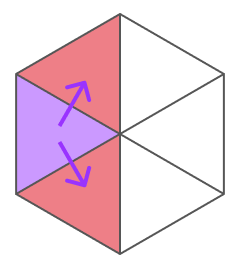
Given a face ID, returns a list of adjacent faces.
| Name | Type | Default | Description |
|---|---|---|---|
faceId | int64 | Face ID for which to get adjacent faces. |
Returns
Array— List of face IDs adjacent to the given face.
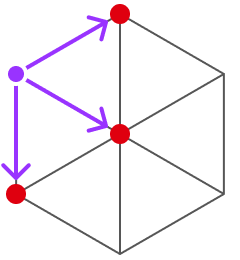
GetAdjacentVertices(vertexId: int64): Array#
Safe
Given a vertex ID, returns a list of adjacent vertices.
| Name | Type | Default | Description |
|---|---|---|---|
vertexId | int64 | Vertex ID around which to get adjacent vertices. |
Returns
Array— List of IDs of adjacent vertices around the given vertex ID.
GetBoneByName(boneName: string): int64#
Safe
Finds the bone ID of the bone with the given name. Errors if no bone with that name exists.
| Name | Type | Default | Description |
|---|---|---|---|
boneName | string | Bone name to search for. |
Returns
int64— Bone ID of the bone with the given name.
GetBoneCFrame(boneId: int64): CFrame#
Safe
Returns the initial CFrame of the bone in the bind pose of the
mesh, in the mesh's local space.
| Name | Type | Default | Description |
|---|---|---|---|
boneId | int64 | Bone ID for which to get the CFrame. |
GetBoneIsVirtual(boneId: int64): boolean#
Safe
Returns true if the bone is virtual. Virtual bones can only be bound to
a FaceControls instance.
| Name | Type | Default | Description |
|---|---|---|---|
boneId | int64 | Bone ID for which to get whether the bone is virtual. |
Returns
boolean— Whether the bone with the given bone ID is virtual. Virtual bones can only be bound to aFaceControlsinstance.
GetBoneName(boneId: int64): string#
Safe
Returns the name string of the bone identified by the given bone ID. Bone names are unique within the mesh and can be up to 100 characters long.
| Name | Type | Default | Description |
|---|---|---|---|
boneId | int64 | Bone ID for which to get the name. |
Returns
string— Name of the bone with the given bone ID.
GetBoneParent(boneId: int64): int64#
Safe
Returns the bone ID of the parent bone in the bone hierarchy. If the bone
has no parent, returns 0.
| Name | Type | Default | Description |
|---|---|---|---|
boneId | int64 | Bone ID for which to get the parent. |
Returns
int64— Bone ID for the parent of the bone with the given bone ID. If there is no parent, returns0.
GetBones(): Array#
Safe
Returns all bones of the mesh as a list of bone IDs.
Returns
Array— List of bone IDs.
GetCenter(): Vector3#
Safe
Returns the center of the mesh's axis-aligned bounding box, in the mesh's local object space.
Returns
Vector3— Center of the bounding box of theEditableMesh.
GetColor(colorId: int64): Color3?#
Safe
Returns the Color3 value stored at the given color ID. Use
GetColorAlpha() to retrieve the alpha
component separately.
| Name | Type | Default | Description |
|---|---|---|---|
colorId | int64 | Color ID for which to get the color. |
Returns
Color3?— Color for the requested color ID.
GetColorAlpha(colorId: int64): float?#
Safe
Returns the alpha component of the vertex color at the given color ID as a
number between 0 (fully transparent) and 1 (fully opaque). Use
GetColor() to retrieve the RGB component.
| Name | Type | Default | Description |
|---|---|---|---|
colorId | int64 | Color ID for which to get the alpha. |
Returns
float?— Color alpha at the request color ID.
GetColors(): Array#
CustomLuaStateSafe
Returns all colors of the mesh as a list of color IDs.
Returns
Array— List of color IDs.
GetFaceColors(faceId: int64): Array#
CustomLuaStateSafe
Returns an array of color IDs, one per vertex corner of the specified
face, in the same order as
GetFaceVertices(). Use these IDs
with GetColor() and
GetColorAlpha() to read the actual
color values.
| Name | Type | Default | Description |
|---|---|---|---|
faceId | int64 | Face ID for which to get the color IDs. |
Returns
Array— List of color IDs used for the vertices on the given face.
GetFaceNormals(faceId: int64): Array#
CustomLuaStateSafe
Returns an array of normal IDs, one per vertex corner of the specified
face, in the same order as
GetFaceVertices(). Use these IDs
with GetNormal() to read the actual
normal vectors.
| Name | Type | Default | Description |
|---|---|---|---|
faceId | int64 | Face ID for which to get the normal IDs. |
Returns
Array— List of normal IDs used for the vertices on the given face.
GetFaces(): Array#
CustomLuaStateSafe
Returns all faces of the mesh as a list of face IDs.
Returns
Array— List of face IDs.
GetFacesWithAttribute(id: int64): Array#
DeprecatedSafeDeprecated
Deprecated. This method is deprecated. Do not use it for new work.
Returns a list of faces that use a given vertex ID, normal ID, UV ID, or color ID.
| Name | Type | Default | Description |
|---|---|---|---|
id | int64 | Attribute ID for which to find faces that use it. |
Returns
Array— List of face IDs which use the given attribute ID.
GetFacesWithColor(colorId: int64): Array#
CustomLuaStateSafe
Returns an array of face IDs that use the given color ID. Use together
with GetVerticesWithColor() to
obtain all face/vertex pairs.
| Name | Type | Default | Description |
|---|---|---|---|
colorId | int64 | Color ID to find faces for. |
Returns
Array— List of face IDs that use the provided color ID.
GetFacesWithNormal(normalId: int64): Array#
CustomLuaStateSafe
Returns an array of face IDs that use the given normal ID. Use together
with GetVerticesWithNormal()
to obtain all face/vertex pairs.
| Name | Type | Default | Description |
|---|---|---|---|
normalId | int64 | Normal ID to find faces for. |
Returns
Array— List of face IDs that use the provided normal ID.
GetFacesWithUV(uvId: int64): Array#
CustomLuaStateSafe
Returns an array of face IDs that use the given UV ID. Use together with
GetVerticesWithUV() to obtain all
face/vertex pairs.
| Name | Type | Default | Description |
|---|---|---|---|
uvId | int64 | UV ID to find faces for. |
Returns
Array— List of face IDs that use the provided UV ID.
GetFaceUVs(faceId: int64): Array#
CustomLuaStateSafe
Returns an array of UV IDs, one per vertex corner of the specified face,
in the same order as
GetFaceVertices(). Use these IDs
with GetUV() to read the actual UV
coordinates.
| Name | Type | Default | Description |
|---|---|---|---|
faceId | int64 | Face ID for which to get the UV IDs. |
Returns
Array— List of UV IDs used for the vertices on the given face.
GetFaceVertices(faceId: int64): Array#
CustomLuaStateSafe
Returns an array of vertex IDs that define the corners of the given face, in the same order used when the face was created.
| Name | Type | Default | Description |
|---|---|---|---|
faceId | int64 | Face ID for which to get the vertex IDs. |
Returns
Array— List of vertex IDs around the given face.
GetFacsCorrectivePose(actions: Array): Tuple#
Safe
Returns bone IDs and bone CFrames for all bones in a
specific FACS corrective pose. Each bone CFrame transforms the
bone from the initial bone CFrame in the bind pose of the mesh
to the combined bone CFrame for this pose. All
CFrames are in the mesh's local space.
| Name | Type | Default | Description |
|---|---|---|---|
actions | Array | Array or 2 or 3 FacsActionUnit values that specify a corrective
pose. |
Returns
Tuple— Array of bone IDs and corresponding array of boneCFrames.
GetFacsCorrectivePoses(): Array#
Safe
Returns all FACS corrective poses that are in use. Each corrective pose is
specified by 2 or 3 FacsActionUnit values.
Returns
Array— Array of corrective poses. Each corrective pose is specified by a small array of 2 or 3FacsActionUnitvalues.
GetFacsPose(action: FacsActionUnit): Tuple#
Safe
Returns bone IDs and bone CFrames for all bones in a
specific FACS action unit. Each bone CFrame transforms the bone
from the initial bone CFrame in the bind pose of the mesh to
the combined bone CFrame for this pose. All
CFrames are in the mesh's local space.
| Name | Type | Default | Description |
|---|---|---|---|
action | FacsActionUnit | FACS action unit for which to get the pose. |
Returns
Tuple— Array of bone IDs and corresponding array of boneCFrame.
GetFacsPoses(): Array#
Safe
Returns an array of FacsActionUnit values representing all base
FACS poses currently defined on this mesh. Use each returned value with
GetFacsPose() to retrieve the bone
transforms for that pose. See also
GetFacsCorrectivePoses() for
corrective poses.
Returns
Array— Array ofFacsActionUnit, one for each FACS action unit that has a pose defined.
GetNormal(normalId: int64): Vector3?#
Safe
Returns the Vector3 normal vector at the given normal ID. If
the normal vector was manually specified it will return that vector. If
the normal vector was not specified or was reset, this will return an
automatically calculated normal vector based on the shape of the mesh.
| Name | Type | Default | Description |
|---|---|---|---|
normalId | int64 | Normal ID for which to get the normal vector. |
Returns
Vector3?— Normal vector at the requested normal ID.
GetNormals(): Array#
CustomLuaStateSafe
Returns all normals of the mesh as a list of normal IDs.
Returns
Array— List of normal IDs.
GetPosition(vertexId: int64): Vector3#
Safe
Gets the position of a vertex in the mesh's local object space.
| Name | Type | Default | Description |
|---|---|---|---|
vertexId | int64 | Vertex ID for which to get the position. |
Returns
Vector3— Position of a vertex in the mesh's local object space.
GetSize(): Vector3#
Safe
Returns the size of the mesh's axis-aligned bounding box, in the mesh's local object space.
Returns
Vector3— Size of theEditableMesh.
GetUV(uvId: int64): Vector2?#
Safe
Returns the Vector2 texture coordinate stored at the given UV
ID. UV coordinates map the mesh surface to a 2D texture.
| Name | Type | Default | Description |
|---|---|---|---|
uvId | int64 | UV ID for which to get the UV coordinate. |
Returns
Vector2?— UV coordinates at the requested UV ID.
GetUVs(): Array#
CustomLuaStateSafe
Returns all UVs of the mesh as a list of UV IDs.
Returns
Array— List of UV IDs.
GetVertexBones(vertexId: int64): Array#
Safe
Returns an array of bone IDs that influence the given vertex during
skinning deformation. A vertex can be influenced by up to 4 bones. The
returned array corresponds index-by-index with the weights returned by
GetVertexBoneWeights() for the
same vertex.
| Name | Type | Default | Description |
|---|---|---|---|
vertexId | int64 | Vertex ID for which to get the associated bones. |
Returns
Array— Bone IDs associated with the vertex for skinning.
GetVertexBoneWeights(vertexId: int64): Array#
Safe
Returns an array of blend weights (each between 0 and 1) for the bones
influencing this vertex during skeletal deformation. The returned array
corresponds index-by-index with the bone IDs returned by
GetVertexBones() for the same
vertex.
| Name | Type | Default | Description |
|---|---|---|---|
vertexId | int64 | Vertex ID for which to get the associated bone weights. |
Returns
Array— Skinning blend weights for each bone that is associated with the vertex.
GetVertexColors(vertexId: int64): Array#
CustomLuaStateSafe
Returns an array of color IDs used on all face corners that reference the given vertex. A vertex shared by multiple faces can have different color IDs on each face (a color seam); this method returns all of them.
| Name | Type | Default | Description |
|---|---|---|---|
vertexId | int64 | Vertex ID to find color IDs. |
Returns
Array— Array of color IDs of faces attached to the given vertex.
GetVertexFaceColor(vertexId: int64, faceId: int64): int64#
Safe
Returns the color ID assigned to a specific corner of a face, identified by the vertex/face pair. This is useful when a vertex is shared by multiple faces and you need the color for one particular face corner rather than all of them.
| Name | Type | Default | Description |
|---|---|---|---|
vertexId | int64 | Vertex ID. | |
faceId | int64 | Face ID. |
Returns
int64— Color ID of the vertex/face pair.
GetVertexFaceNormal(vertexId: int64, faceId: int64): int64#
Safe
Returns the normal ID assigned to a specific corner of a face, identified by the vertex/face pair. This is useful when a vertex has split normals (a sharp edge) and you need the normal for one particular face corner rather than all of them.
| Name | Type | Default | Description |
|---|---|---|---|
vertexId | int64 | Vertex ID. | |
faceId | int64 | Face ID. |
Returns
int64— Normal ID of the vertex/face pair.
GetVertexFaces(vertexId: int64): Array#
CustomLuaStateSafe
Returns an array of face IDs for all faces that have the given vertex as one of their corners. Use this to traverse the mesh topology around a vertex, for example to find all faces affected by moving a vertex.
| Name | Type | Default | Description |
|---|---|---|---|
vertexId | int64 | Vertex ID to find faces for. |
Returns
Array— Array of face IDs attached to the given vertex.
GetVertexFaceUV(vertexId: int64, faceId: int64): int64#
Safe
Returns the UV ID assigned to a specific corner of a face, identified by the vertex/face pair. This is useful when a vertex has a UV seam and you need the UV for one particular face corner rather than all of them.
| Name | Type | Default | Description |
|---|---|---|---|
vertexId | int64 | Vertex ID. | |
faceId | int64 | Face ID. |
Returns
int64— UV ID of the vertex/face pair.
GetVertexNormals(vertexId: int64): Array#
CustomLuaStateSafe
Returns an array of normal IDs used on all face corners that reference the given vertex. A vertex shared by multiple faces can have different normal IDs on each face (a hard/sharp edge); this method returns all of them.
| Name | Type | Default | Description |
|---|---|---|---|
vertexId | int64 | Vertex ID to find normal IDs. |
Returns
Array— Array of normal IDs of faces attached to the given vertex.
GetVertexUVs(vertexId: int64): Array#
CustomLuaStateSafe
Returns an array of UV IDs used on all face corners that reference the given vertex. A vertex shared by multiple faces can have different UV IDs on each face (a UV seam); this method returns all of them.
| Name | Type | Default | Description |
|---|---|---|---|
vertexId | int64 | Vertex ID to find UV IDs. |
Returns
Array— Array of UV IDs of faces attached to the given vertex.
GetVertices(): Array#
Safe
Returns all vertex IDs in the mesh as a list of IDs. The IDs may not be contiguous. Use this list to iterate over vertices safely, rather than assuming consecutive numbering.
Returns
Array— List of vertex IDs.
GetVerticesWithAttribute(id: int64): Array#
DeprecatedSafeDeprecated
Deprecated. This method is deprecated. Do not use it for new work.
Returns a list of vertices that use a given face ID, normal ID, UV ID, or color ID.
| Name | Type | Default | Description |
|---|---|---|---|
id | int64 | Attribute ID for which to find vertices that use it. |
Returns
Array— List of vertex IDs which use the given attribute ID.
GetVerticesWithColor(colorId: int64): Array#
CustomLuaStateSafe
Returns an array of vertex IDs that use the given color ID. Use together
with GetFacesWithColor() to
obtain all face/vertex pairs.
| Name | Type | Default | Description |
|---|---|---|---|
colorId | int64 | Color ID to find faces for. |
Returns
Array— List of face IDs that use the provided color ID.
GetVerticesWithNormal(normalId: int64): Array#
CustomLuaStateSafe
Returns an array of vertex IDs that use the given normal ID. Use together
with GetFacesWithNormal() to
obtain all face/vertex pairs.
| Name | Type | Default | Description |
|---|---|---|---|
normalId | int64 | Normal ID to find vertices for. |
Returns
Array— List of vertex IDs that use the provided normal ID.
GetVerticesWithUV(uvId: int64): Array#
CustomLuaStateSafe
Returns an array of vertex IDs that use the given UV ID. Use together with
GetFacesWithUV() to obtain all
face/vertex pairs.
| Name | Type | Default | Description |
|---|---|---|---|
uvId | int64 | UV ID to find vertices for. |
Returns
Array— List of vertex IDs that use the provided UV ID.
IdDebugString(id: int64): string#
Returns a string describing an ID, useful for debugging purposes, like
f17 or v12, containing the type, ID number, and version.
| Name | Type | Default | Description |
|---|---|---|---|
id | int64 | ID for which to return a debugging information string. |
Returns
string— String that describes the ID in human-readable format.
MergeVertices(mergeTolerance: float): Map#
Merges vertices that touch together, to use a single vertex ID but keep the other original attribute IDs.
| Name | Type | Default | Description |
|---|---|---|---|
mergeTolerance | float | The distance at which the vertices are considered to touch each other. |
Returns
Map— A mapping of old vertex ID to new vertex ID for vertices that have been merged.
RaycastLocal(origin: Vector3, direction: Vector3): Tuple#
Safe
Casts a ray and returns the face ID, point of intersection, barycentric coordinates, and the 3 vertex IDs that the barycentric coordinates correspond to. The inputs and outputs of this method are in the mesh's local object space. When the mesh is skinned, this raycast operates against the bind-pose geometry, not the deformed mesh as it appears at runtime.
A barycentric coordinate is a way of specifying a point within a triangle as a weighted combination of the triangle's 3 vertices. This is useful as a general way of blending vertex attributes. See this method's code sample as an illustration.
Because a barycentric coordinate is defined over exactly 3 vertices, when the hit face is a quad, the coordinate and the returned vertex IDs refer to 3 of the quad's 4 vertices forming the corners of the sub-triangle that was hit. Use the returned vertex IDs, rather than the face's full vertex list, to identify which vertices the weights apply to.
| Name | Type | Default | Description |
|---|---|---|---|
origin | Vector3 | Origin of the ray in the mesh's local object space. | |
direction | Vector3 | Direction of the ray. |
Returns
Tuple— Tuple of the face ID, point of intersection, barycentric coordinates, and the 3 vertex IDs that the barycentric coordinates weight.
RemoveBone(boneId: int64): ()#
Removes a bone from the mesh using its bone ID. Any vertex skinning weights that referenced the removed bone are also cleared.
| Name | Type | Default | Description |
|---|---|---|---|
boneId | int64 | Bone ID of the bone to remove. |
Returns
()
RemoveFace(faceId: int64): ()#
Removes a face from the mesh using its face ID. The vertices and
attributes that were used by the face are not automatically deleted;
call RemoveUnused() afterward if you
want to clean up unused vertices and attributes.
| Name | Type | Default | Description |
|---|---|---|---|
faceId | int64 | Face ID of the face to remove. |
Returns
()
RemoveUnused(): Array#
Removes all vertices, normals, UVs, and colors which are not used in any face, and returns the removed IDs.
Returns
Array— All of the removed IDs.
ResetNormal(normalId: int64): ()#
Reset this normal ID to be automatically calculated based on the shape of the mesh, instead of manually set.
| Name | Type | Default | Description |
|---|---|---|---|
normalId | int64 | Normal ID to reset. |
Returns
()
SetBoneCFrame(boneId: int64, cframe: CFrame): ()#
Set the initial CFrame for a bone in the mesh's bind pose, in
the mesh's local space.
| Name | Type | Default | Description |
|---|---|---|---|
boneId | int64 | Bone ID for which to set the initial CFrame. | |
cframe | CFrame | Initial CFrame for the bone in the mesh's bind pose, in the
mesh's local space. |
Returns
()
SetBoneIsVirtual(boneId: int64, virtual: boolean): ()#
Set whether a bone is virtual. Virtual bones can only be bound to a
FaceControls instance.
| Name | Type | Default | Description |
|---|---|---|---|
boneId | int64 | Bone ID for which to set whether the bone is virtual. | |
virtual | boolean | Whether the bone should be virtual. |
Returns
()
SetBoneName(boneId: int64, name: string): ()#
Sets the name for a bone. Bone names can be 100 characters long and must be unique in the mesh.
| Name | Type | Default | Description |
|---|---|---|---|
boneId | int64 | Bone ID for which to set the name. | |
name | string | Bone name to set. |
Returns
()
SetBoneParent(boneId: int64, parentBoneId: int64): ()#
Sets the parent of a bone in the bone hierarchy. Pass a valid bone ID to
parent the bone, or 0 to make it a root bone. The engine validates that
the new parent does not create a cycle in the bone hierarchy and throws an
error if the parent ID is invalid or would produce a circular dependency.
| Name | Type | Default | Description |
|---|---|---|---|
boneId | int64 | Bone ID for which to set the parent. | |
parentBoneId | int64 | Parent bone ID. |
Returns
()
SetColor(colorId: int64, color: Color3): ()#
Sets the Color3 value for a color ID. This changes the vertex
color for every face corner that references this color ID. Use
SetColorAlpha() to change the alpha
component separately.
| Name | Type | Default | Description |
|---|---|---|---|
colorId | int64 | Color ID for which to set the color. | |
color | Color3 | Color to set. |
Returns
()
SetColorAlpha(colorId: int64, alpha: float): ()#
Sets the alpha (transparency) component of the vertex color at the given
color ID. The value is a number between 0 (fully transparent) and 1
(fully opaque). This changes the alpha for every face corner that
references this color ID.
| Name | Type | Default | Description |
|---|---|---|---|
colorId | int64 | Color ID for which to set the color alpha. | |
alpha | float | Alpha to set. |
Returns
()
SetFaceColors(faceId: int64, ids: Array): ()#
CustomLuaState
Assigns new color IDs to the corners of a face, replacing whatever color
IDs were previously set. The array must contain one color ID per vertex of
the face, in the same winding order as
GetFaceVertices(). Use this to
create a color seam at a vertex shared by multiple faces.
| Name | Type | Default | Description |
|---|---|---|---|
faceId | int64 | Face ID for which to update the vertex colors. | |
ids | Array | List of new color IDs to use for the given face's vertices. |
Returns
()
SetFaceNormals(faceId: int64, ids: Array): ()#
CustomLuaState
Assigns new normal IDs to the corners of a face, replacing whatever normal
IDs were previously set. The array must contain one normal ID per vertex
of the face, in the same winding order as
GetFaceVertices(). Use this to
create a hard/sharp edge by giving adjacent faces different normals at the
same vertex.
| Name | Type | Default | Description |
|---|---|---|---|
faceId | int64 | Face ID for which to update the vertex normals. | |
ids | Array | List of new normal IDs to use for the given face's vertices. |
Returns
()
SetFaceUVs(faceId: int64, ids: Array): ()#
CustomLuaState
Assigns new UV IDs to the corners of a face, replacing whatever UV IDs
were previously set. The array must contain one UV ID per vertex of the
face, in the same winding order as
GetFaceVertices(). Use this to
create a UV seam at a vertex shared by multiple faces.
| Name | Type | Default | Description |
|---|---|---|---|
faceId | int64 | Face ID for which to update the vertex UVs. | |
ids | Array | List of new UV IDs to use for the given face's vertices. |
Returns
()
SetFaceVertices(faceId: int64, ids: Array): ()#
CustomLuaState
Replaces the vertex IDs at each corner of the given face, in winding order. Passing 3 vertex IDs makes the face a triangle and 4 makes it a quad, so this can convert a face between a triangle and a quad while keeping the same face ID.
The normal, UV, and color attributes on each of the existing corners are
preserved. If a new corner is added, it follows the same automatic
attribute assignment described in
AddFace().
| Name | Type | Default | Description |
|---|---|---|---|
faceId | int64 | Face ID for which to update the vertices. | |
ids | Array | List of new vertex IDs to use for the given face. |
Returns
()
SetFacsBonePose(action: FacsActionUnit, boneId: int64, cframe: CFrame): ()#
Sets the CFrame for a single bone within a specific FACS action
unit pose, without modifying the other bones in that pose. The bone must
be virtual. The CFrame transforms the bone from its initial
bind-pose position to the target pose position, in the mesh's local space.
Use this for incremental edits to a FACS pose; use
SetFacsPose() to set all bones in a
pose at once.
| Name | Type | Default | Description |
|---|---|---|---|
action | FacsActionUnit | FACS action unit for which to set the pose. | |
boneId | int64 | Bone to set a CFrame for this pose. | |
cframe | CFrame | CFrame which transforms the bone from the initial bone
CFrame in the bind pose of the mesh to the combined bone
CFrame for this pose. All CFrames are in
the mesh's local space. |
Returns
()
SetFacsCorrectivePose(actions: Array, boneIds: Array, cframes: Array): ()#
Sets all bone transforms for a FACS corrective pose, which overrides the
blended result of 2 or 3 base poses when they are active simultaneously.
The actions array must contain exactly 2 or 3 FacsActionUnit
values that identify the combination. All referenced bones must be
virtual. The boneIds and cframes arrays must be the same length; each
CFrame transforms the bone from the bind pose to the corrective
target, in the mesh's local space. Throws if the action combination is not
a valid corrective.
| Name | Type | Default | Description |
|---|---|---|---|
actions | Array | Array or 2 or 3 FacsActionUnit values to apply as a corrective
pose. | |
boneIds | Array | Bones to set a CFrame for this pose. | |
cframes | Array | CFrame transforms for the bones in this corrective pose.
Each bone |
Returns
()
SetFacsPose(action: FacsActionUnit, boneIds: Array, cframes: Array): ()#
Sets all bone transforms for a FACS base pose (a single action unit). The
boneIds and cframes arrays must be the same length; each
CFrame transforms the bone from the bind pose to the target
pose, in the mesh's local space. All referenced bones must be virtual
(non-virtual bones throw an error). This replaces any previously defined
pose for the given action unit.
| Name | Type | Default | Description |
|---|---|---|---|
action | FacsActionUnit | FACS action unit to set the pose for. | |
boneIds | Array | Bones for which to set a CFrame for this pose. | |
cframes | Array | CFrame transforms for the bones in this pose.
Each bone |
Returns
()
SetNormal(normalId: int64, normal: Vector3): ()#
Set the normal for a normal ID. This will change the normal value for every face vertex which is using the normal ID.
| Name | Type | Default | Description |
|---|---|---|---|
normalId | int64 | Normal ID for which to set the normal vector. | |
normal | Vector3 | Normal vector to set. |
Returns
()
SetPosition(vertexId: int64, p: Vector3): ()#
Sets a vertex position in the mesh's local object space. Please note that
collision and other physics data on linked MeshParts is
not updated until you call AssetService:CreateMeshPartAsync() and
MeshPart:ApplyMesh().
| Name | Type | Default | Description |
|---|---|---|---|
vertexId | int64 | Vertex ID of the vertex to position. | |
p | Vector3 | Position in the mesh's local object space. |
Returns
()
SetUV(uvId: int64, uv: Vector2): ()#
Sets the Vector2 texture coordinate for a UV ID. This changes
the UV mapping for every face corner that references this UV ID.
| Name | Type | Default | Description |
|---|---|---|---|
uvId | int64 | UV ID for which to set the UV coordinates. | |
uv | Vector2 | UV coordinates. |
Returns
()
SetVertexBones(vertexId: int64, boneIDs: Array): ()#
Assign a list of bones with the vertex for skinning.
Corresponds with the skinning blend weights used in
SetVertexBoneWeights(). In
other words,
GetVertexBoneWeights(vertexId)[i]
is the weight on this vertex for
GetVertexBones(vertexId)[i].
This method should be called before calling
SetVertexBoneWeights().
| Name | Type | Default | Description |
|---|---|---|---|
vertexId | int64 | Vertex ID to set vertex skinning bones. | |
boneIDs | Array | Bone IDs to use with this vertex for skinning. |
Returns
()
SetVertexBoneWeights(vertexId: int64, boneWeights: Array): ()#
Sets skinning blend weights for each bone associated with the vertex.
Corresponds with the bone IDs used in
SetVertexBones(). In other words,
GetVertexBoneWeights(vertexId)[i]
is the weight on this vertex for
GetVertexBones(vertexId)[i].
This method should be called after calling
SetVertexBones().
| Name | Type | Default | Description |
|---|---|---|---|
vertexId | int64 | Vertex ID on which to set skinning blend weights. | |
boneWeights | Array | Skinning blend weights to set on the vertex. |
Returns
()
SetVertexFaceColor(vertexId: int64, faceId: int64, colorId: int64): ()#
Sets the color ID for a specific corner of a face, identified by the
vertex/face pair. This is equivalent to changing just one element of the
array set by SetFaceColors(), and is
useful for creating or removing a color seam at a single vertex without
affecting the other corners of the face.
| Name | Type | Default | Description |
|---|---|---|---|
vertexId | int64 | Vertex ID. | |
faceId | int64 | Face ID. | |
colorId | int64 | Color ID to set for the vertex/face pair. |
Returns
()
SetVertexFaceNormal(vertexId: int64, faceId: int64, normalId: int64): ()#
Sets the normal ID for a specific corner of a face, identified by the
vertex/face pair. This is equivalent to changing just one element of the
array set by SetFaceNormals(), and
is useful for creating or removing a hard edge at a single vertex without
affecting the other corners of the face.
| Name | Type | Default | Description |
|---|---|---|---|
vertexId | int64 | Vertex ID. | |
faceId | int64 | Face ID. | |
normalId | int64 | Normal ID to set for the vertex/face pair. |
Returns
()
SetVertexFaceUV(vertexId: int64, faceId: int64, uvId: int64): ()#
Sets the UV ID for a specific corner of a face, identified by the
vertex/face pair. This is equivalent to changing just one element of the
array set by SetFaceUVs(), and is useful
for creating or removing a UV seam at a single vertex without affecting
the other corners of the face.
| Name | Type | Default | Description |
|---|---|---|---|
vertexId | int64 | Vertex ID. | |
faceId | int64 | Face ID. | |
uvId | int64 | UV ID to set for the vertex/face pair. |
Returns
()
Triangulate(): ()#
Splits every quad face on the mesh into two triangle faces each. A
heuristic is used to determine which diagonal each quad should be split
along to produce better-shaped triangles. If your code relies on faces
being triangles, call this method after
AssetService:CreateEditableMeshAsync(), which may produce quad
faces.
Returns
()